TDK Bets $260 Million on Inductor Capacity as AI Servers Chase Efficiency
Japanese component maker plans three-year factory expansion to meet surging demand for thin-film inductors that reduce energy waste in data centres
The Efficiency Bottleneck Behind the AI Boom
TDK has committed roughly $260 million across two manufacturing sites over the next three years to expand capacity for thin-film inductors, according to the company. The move reflects a broader shift in the AI infrastructure stack: as training runs and inference workloads push power consumption into the gigawatt range, data centre operators are hunting for marginal gains anywhere electrons flow.
Thin-film inductors sit on server boards and inside power-delivery circuits, smoothing voltage and curbing energy loss at the microwatt scale. Individually they are unremarkable; collectively, across racks of accelerators running twenty-four hours, they determine whether a hyperscaler pays for an extra substation or squeezes another percentage point of utilisation from existing grid connections. At Opentechwire, we have tracked component shortages ripple through AI deployments before - memory, advanced packaging substrates, even cooling pumps - but power-stage passives rarely made headlines until thermal-design budgets started including their losses in system-level calculations.
Why Inductors Matter Now
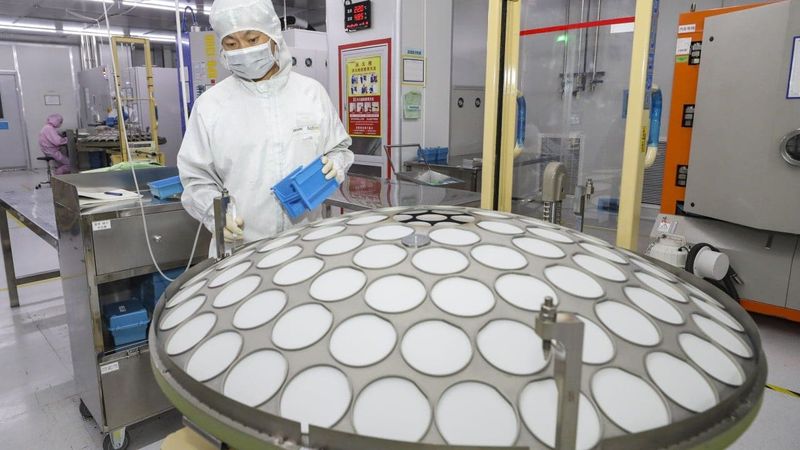
Traditional wire-wound inductors have served electronics for decades, but AI server motherboards demand parts that occupy less board space, tolerate higher switching frequencies, and dissipate less heat. Thin-film inductors meet those specifications by depositing magnetic layers and copper coils in photolithographic steps, much like semiconductor fabrication. The result is a component a few millimetres across that can handle tens of amperes with lower DC resistance than wire-wound equivalents.
Energy efficiency regulations in the European Union and California now include idle-state and partial-load metrics for data centre equipment, which penalise resistive losses even when servers are not at full throttle. Hyperscalers have also published sustainability commitments that hinge on power-usage effectiveness below 1.2, a target difficult to reach if passive components bleed watts across every voltage rail. TDK's capacity expansion suggests it expects those regulatory and commercial pressures to persist well into the next hardware refresh cycle.
Where the Investment Lands
The company plans to direct capital towards two existing facilities, though it has not publicly named the sites. Industry practice in Japan often sees passive-component makers consolidate production in domestic plants for advanced variants - where process control and yield matter - while shifting mature products to Southeast Asian lines. TDK operates factories in Akita and Niigata prefectures, both of which have hosted inductor and capacitor lines in the past.
Three years is a relatively short horizon for a capacity doubling in passive components, which typically require clean-room environments and multi-step deposition tools. The timeline implies TDK will install additional equipment in existing buildings rather than construct greenfield fabs, a faster route but one constrained by floor space and utility headroom. If AI server demand softens before the lines reach full output, the company will have less flexibility to repurpose thin-film tooling than it would with general-purpose assembly equipment.
The Competitive Context in Passives
TDK is not alone in eyeing AI infrastructure. Murata Manufacturing, another Kyoto-based giant, has invested in multilayer ceramic capacitors optimised for GPU power delivery, and Taiwan's Yageo has expanded its high-frequency inductor catalogue. The passive-component market has historically been a volume game with thin margins, but AI servers command premium pricing because design-wins lock in multi-year supply agreements and because failures in the field carry steep penalties - data centre operators cannot afford board-level faults when uptime commitments approach five nines.
We have also observed vertical integration attempts: some hyperscalers have begun co-designing power stages with original design manufacturers, specifying inductors and capacitors by electrical parameters rather than by vendor part number. That trend could eventually pressure TDK and its peers to offer more customisation, or risk commoditisation if server makers treat passives as interchangeable.
Risks Embedded in the Bet
A quarter-billion dollars is modest by semiconductor standards but significant for a component category where product life-cycles stretch across decades. TDK's investment assumes AI server deployments will continue to scale, that power-efficiency requirements will tighten, and that thin-film inductors will remain the preferred solution over potential alternatives such as integrated voltage regulators or gallium-nitride power stages that shift losses elsewhere in the system.
If the AI infrastructure build-out plateaus - whether from capital discipline among hyperscalers, breakthroughs in algorithmic efficiency that reduce compute intensity, or geopolitical export controls that fragment supply chains - TDK will find itself with underutilised lines. The company has not disclosed the expected payback period, nor has it provided output-volume targets that would let analysts model unit economics.
What the Move Signals for Supply Chains
TDK's announcement is one more data point suggesting that the AI hardware stack is maturing beyond GPUs and high-bandwidth memory into the supporting cast of power delivery, cooling, and board-level passives. At Opentechwire, we expect procurement teams at server OEMs to secure long-term agreements for inductors and capacitors in 2025 and 2026, mirroring the supply-chain playbook that unfolded in advanced packaging two years earlier.
For component suppliers in the region - particularly those in Japan, South Korea, and Taiwan - the question is whether they can scale quickly enough to capture design-wins before the current wave of AI server architectures gives way to the next. TDK's three-year timeline suggests it believes this window will stay open at least that long, a bet that will be tested by both technology shifts and macroeconomic headwinds in the data centre sector.
The inductor expansion is a measured wager on the proposition that efficiency, not just raw performance, will define the next phase of AI infrastructure - and that the companies who supply the invisible components will share in the returns.