The Storage Trap Behind Every AI Prompt
As inference scales, enterprises discover that back-end data footprints grow faster than GPU budgets - and the CFO's line item is starting to show it.
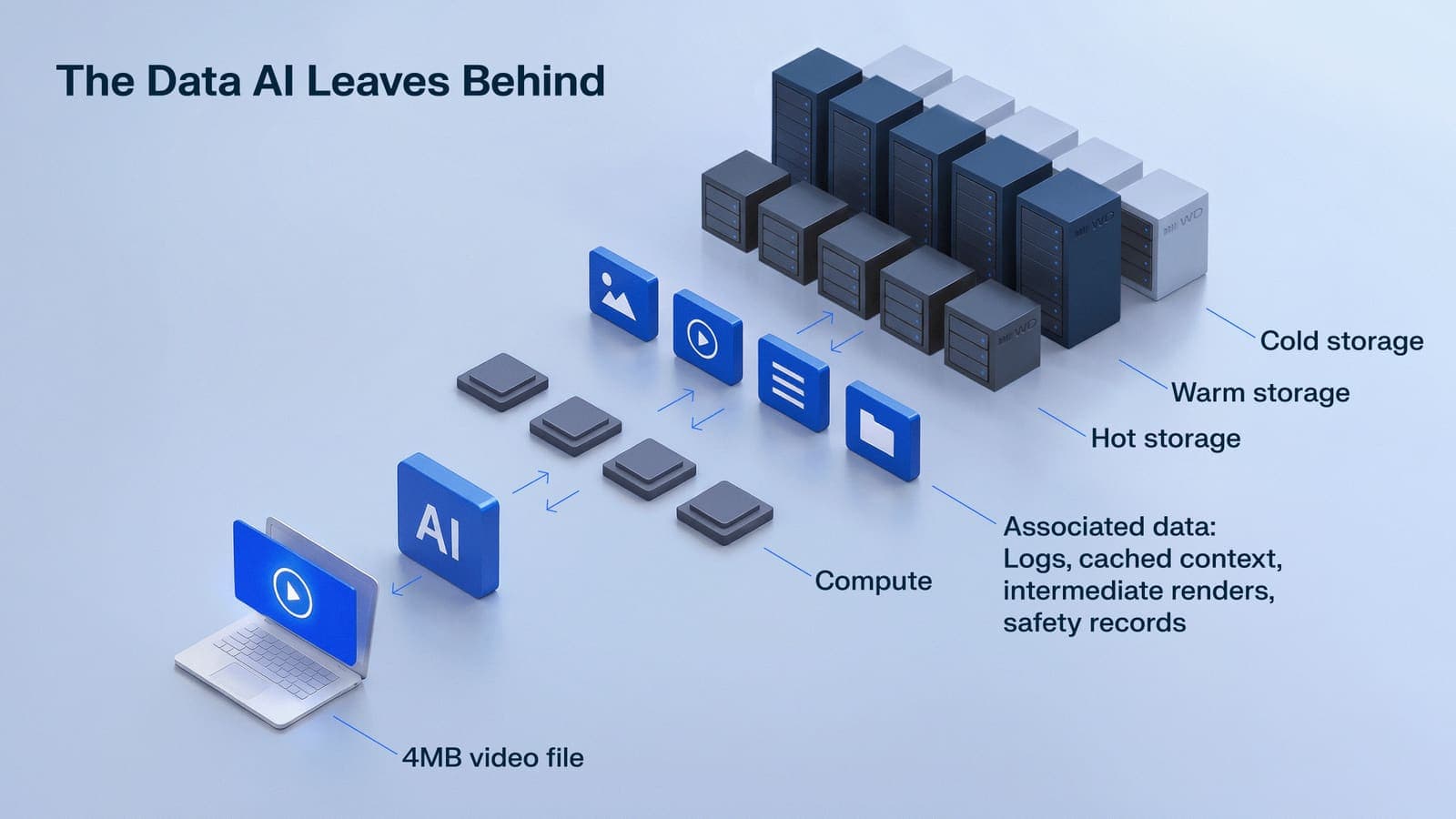
The Invisible Accumulation
An 8-second AI-generated video clip delivered to a user as a 4 MB file can leave more than 500 MB of data on the back end. Logs, cached context, intermediate renders, backups, compliance records - none of it disappears when the task completes. Scale that to enterprise workloads producing longer, higher-resolution outputs, and a single clip can generate hundreds of gigabytes of retained artefacts.
This ratio - output to back-end footprint - is emerging as one of the less visible but more persistent cost drivers in production AI. Executives budget for GPUs, power, and model licences. Storage often appears as a rounding error. But inference doesn't retire the way training runs do. Every prompt answered, every image synthesised, every document processed leaves something behind. Twelve months later, the rounding error has become a material line item, and the procurement team is scrambling to explain why capacity projections missed by 40 per cent.
At Opentechwire, we've tracked infrastructure spend across hyperscalers and enterprise AI deployments in Singapore, Seoul, and Shenzhen. The pattern is consistent: compute costs follow predictable cycles tied to hardware refreshes and product launches. Storage costs compound. They don't fall back down when a training run ends or when a model goes into maintenance. Data accumulates, and organisations are holding onto more of it for longer because the strategic value of retained AI-generated content is rising.
Inference Economics Versus Training Economics
Training a large language model or a video diffusion model is a finite project. It consumes compute over weeks or months, then concludes. You can budget it, retire the infrastructure, and move on. Inference is continuous. Every query, every generation, every retrieval-augmented prompt creates new data that must be stored, indexed, and made available for future workflows.
IDC surveyed 763 IT and business decision makers globally and found that nearly 95 per cent reported increased data volumes due to generative AI over the past year. Roughly 61 per cent saw growth of 25 per cent or more. Meanwhile, McKinsey projects AI inference demand will expand at a 35 per cent compound annual growth rate through 2030, compared with 22 per cent for training, and will represent more than 40 per cent of total data centre demand by decade's end.
The mismatch is structural. Compute budgets are planned around discrete projects and hardware lifecycles. Storage budgets are planned - if they're planned at all - around historical growth rates that no longer apply. A hyperscale cloud provider's senior product manager put it plainly in the IDC research: keeping GPUs busy depends on ensuring they never wait for data. Hours of idle GPU time become expensive very quickly. That means storage isn't a passive repository; it's an operational dependency. If your storage layer can't deliver data fast enough, your accelerators sit idle, and you're paying for both the compute you're not using and the storage bottleneck you didn't anticipate.
What Accumulates and Why It Matters
The data that inference leaves behind isn't uniform. Some of it is performance telemetry - logs that track latency, token throughput, and error rates. Some is regulatory or compliance artefacts: records of what the model generated, when, and for whom. Some is intermediate state: cached embeddings, partially rendered outputs, and context windows that might be reused in follow-up queries.
In video generation workloads, the back-end footprint can exceed the delivered file size by more than 100 times. In retrieval-augmented generation pipelines, every query stores not just the answer but the documents retrieved, the embeddings computed, and the provenance chain needed to audit the response. In claims processing, underwriting, or contract review - domains where AI is moving from pilot to production across Asia-Pacific - every document run through a model creates artefacts that legal, compliance, and audit teams expect to retrieve on demand.
This changes the role of archived data. Information that once moved into cold storage and stayed there is now an input to future AI workloads. Ninety-six per cent of respondents in the WD-IDC survey anticipate needing faster archive retrieval to support inference or RAG. That means storage infrastructure must support not only growing capacity but increasingly dynamic access patterns. Data that was written once and read rarely is now written once and read unpredictably, often months after it was created.
The Budget Disconnect
For a CFO or CIO, the implication is that "AI infrastructure spend" is scoped too narrowly if it focuses on compute alone. A model idling while data loads costs roughly the same as one idling for lack of a GPU. But the storage bottleneck stays hidden until it surfaces in operating costs, retrieval delays, or unplanned CapEx requests.
Consider a retailer generating AI product videos for an online catalogue. The compute cost per video is a known quantity: a per-generation rate that finance can forecast. The storage cost is different. It compounds with every video produced, because the back-end data doesn't disappear once the task finishes. A team that budgets AI as "compute plus a small allowance for storage" may discover, 12 to 18 months in, that the allowance has become a significant fraction of the programme's total cost - precisely when leadership is deciding whether to expand.
Or consider an insurer running claims documents through a RAG pipeline to accelerate underwriting. Every claim processed generates embeddings, retrieval logs, and audit trails. The compute cost is tied to the number of claims. The storage cost is tied to the number of claims multiplied by the retention period multiplied by the back-end footprint per claim. If the retention period extends from one year to three - because regulators require it, or because the data proves useful for model fine-tuning - the storage cost triples without a corresponding increase in compute.
This is where budget assumptions break. Compute scales with workload intensity. Storage scales with cumulative output. They don't move in parallel, and most finance teams don't model them separately.
Architecting for Cumulative Data
Addressing this starts with recognising that AI data has a lifecycle, and that lifecycle is longer and more active than traditional archive patterns suggest. Data moves from hot tiers - accessed constantly, stored on high-performance media - to warm, cool, and cold tiers as access frequency declines. But in AI workloads, data that's months old can suddenly become relevant again when it's pulled into a RAG retrieval set or used to fine-tune a model.
That means storage strategy can't be designed exclusively for hot-tier performance. Most AI data by volume accumulates in the cooler tiers, and those tiers must balance capacity, cost, power consumption, and retrieval speed. High-density hard disk drives, for instance, offer a cost-per-terabyte advantage that becomes material when you're storing petabytes of inference artefacts. But they must be deployed in architectures that don't sacrifice retrieval performance when that cold data is suddenly needed.
Economically scalable capacity means infrastructure designed for the full data lifecycle: performance where it's needed, capacity where data accumulates, and retrieval speed that doesn't degrade as volume grows. It also means setting retention policies based on data's strategic value rather than its original storage cost. If embeddings generated six months ago can improve a model's accuracy today, they're not cold archive - they're an asset.
Operationally, this requires thinking about storage in fleets, not individual drives. Power consumption, density, reliability, and failure rates all determine whether the system remains economically sustainable as capacity scales into the hundreds of petabytes. A storage tier that costs 10 per cent less per terabyte but consumes 20 per cent more power may not be cheaper once you account for multi-year operating costs in a Singapore or Hong Kong data centre, where power and cooling are expensive.
Three Questions Finance Should Ask
There are three diagnostic questions worth asking before the next budget cycle:
First, what is your organisation's data retention policy for AI-generated content, and who set it? In many enterprises, retention periods are inherited from previous IT regimes or set by individual engineering teams without coordination. The result is inconsistent: some teams delete inference logs after 30 days, others keep them indefinitely. That inconsistency becomes a cost problem when one team's indefinite retention fills a storage array that another team was counting on.
Second, is your storage procurement tied to training-time performance needs, or to the actual lifecycle of the data you're producing? Training workloads favour high-throughput, low-latency storage. Inference workloads generate data that must be retained, indexed, and retrieved unpredictably. If your storage architecture is optimised for the former, it's likely over-provisioned for some workloads and under-provisioned for others.
Third, if your AI usage doubled next year, would your storage cost double with it - or worse? If the answer is "worse," you have a compounding problem. Doubling inference volume doesn't just double the data generated; it can more than double the back-end footprint if outputs grow in complexity or retention periods lengthen.
Most organisations cannot answer all three questions with confidence. That gap is worth closing now, before the next wave of inference workloads moves from pilot to production. The enterprises that do close it will have a structural cost advantage over those that treat storage as an afterthought until the budget meeting reveals otherwise.
What This Means for Asia-Pacific Deployments
The dynamic is particularly acute in Asia-Pacific, where hyperscale cloud adoption is growing faster than in mature Western markets, and where enterprises are deploying AI in production earlier in the technology's lifecycle. A Singaporean e-commerce platform generating product videos at scale, a South Korean financial institution running RAG over regulatory filings, a Chinese autonomous vehicle company storing sensor logs and inference telemetry - all face the same challenge: compute costs are visible and budgeted, storage costs accumulate silently until they're not silent anymore.
The funding rounds we've followed across the region show capital flowing into AI infrastructure, but the pitch decks and term sheets focus overwhelmingly on compute: GPU clusters, inference optimisation, model efficiency. Storage is mentioned, if at all, as a line item under "supporting infrastructure." That framing will need to shift. The enterprises that build economically sustainable AI operations will be the ones that plan for cumulative data from the start, not the ones that discover the storage bill 18 months into production.
Infrastructure decisions made today - what storage architectures to deploy, what retention policies to set, how to balance performance and capacity across tiers - will determine which AI programmes scale profitably and which hit a cost ceiling that forces them to pause, re-architect, or shut down. The storage trap isn't hypothetical. It's already closing on teams that assumed the GPU budget was the only number that mattered.