Range-Extended Electric Vehicles Find Loophole in EU Hybrid Quota
A cap on Chinese hybrid imports excludes EREVs, prompting manufacturers to reposition a niche powertrain as their new route into European markets
The Quota and the Exception
Brussels and Beijing reached an agreement in October that caps annual imports of Chinese-made hybrid vehicles to the European Union at 350,000 units, with the restriction scheduled to take effect on 1 December pending member-state approval. Yet the limit contains a technical carve-out: range-extended electric vehicles will not count against the quota, multiple industry executives have confirmed.
That distinction rests on powertrain architecture. Range-extended electric vehicles use a small internal-combustion engine solely to generate electricity for an onboard battery, rather than to drive the wheels directly. The European Commission's definition treats them as a separate category from conventional plug-in hybrids, where the engine and motor both contribute mechanical propulsion.
For Chinese manufacturers already navigating tariffs as high as 35 per cent, the exclusion offers a fresh channel into a market that had appeared to narrow sharply. In China's domestic market, range-extended models took 8.6 per cent of combined electric and hybrid sales in October, concentrated in large family vehicles. By contrast, they represent less than half a percentage point of Europe's electric vehicle registrations, leaving ample room for category growth.
Strategic Repositioning Under Way
Several manufacturers have begun to reorient their European portfolios. Xpeng, which fields eight range-extended models in China, confirmed it is monitoring regulatory developments and intends to broaden powertrain choice for European customers. Earlier in 2026 the company introduced its first European range-extended model, a vehicle delivering a combined 1,000 kilometres of range on a full charge and a full tank. The L03 coupe carries a starting price of €41,095 and emits 11 grams of carbon dioxide per kilometre, according to the manufacturer. For comparison, the plug-in hybrid variant of Volkswagen's Tiguan sport utility vehicle starts at €52,215 in Germany and emits 34 grams per kilometre.
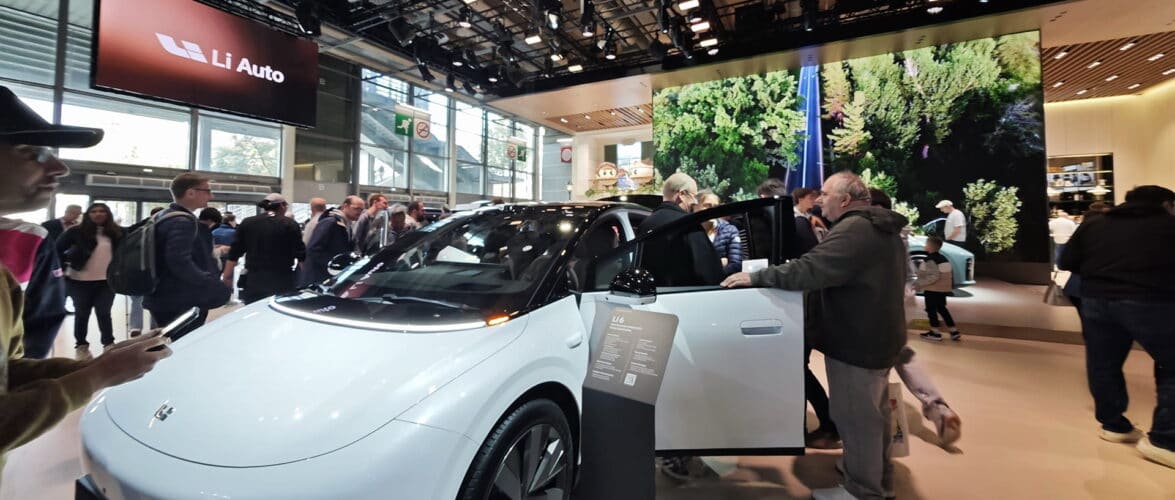
Li Auto, which captured roughly a quarter of China's range-extended market in 2025 and pioneered the segment domestically, announced plans at the Paris Motor Show in October to bring both battery-electric and range-extended vehicles to Europe. Leapmotor, backed by Stellantis, launched the C10 sport utility vehicle in Europe in 2025, becoming the first Chinese brand to sell a range-extended model in the bloc, and followed with the B10 this year. At the Paris exhibition it displayed the D19, built on a new range-extended platform.
Aito, a brand owned by Seres and supported by Huawei, is assessing market requirements and aims to introduce as many models as possible to European buyers in the autumn of 2027, according to Clifford Kang, vice president at Seres. The brand exhibited four sport utility vehicles in Paris, all available in China with both range-extended and battery-electric configurations.
Appeal Beyond the Battery Anxious
Range-extended vehicles occupy a middle ground between conventional hybrids and pure battery-electric cars. They allow drivers to operate on electric power for daily commuting while retaining the flexibility of a liquid-fuel tank for longer trips, a feature that addresses persistent concerns over charging infrastructure and driving range.
Felix Hamer, an Amsterdam-based blogger who maps electric vehicle charging networks across Europe, described range-extended models as an easy proposition for consumers hesitant to abandon familiar refuelling habits. "They can all take this fear away so that you don't have to learn new" behaviours, he noted.
Analysts point out that despite the tariff burden, range-extended vehicles sold in Europe can sustain high margins. Matthias Schmidt, founder of Schmidt Automotive Research, observed that once manufacturers establish brand recognition, pricing tends to stabilise and profitability improves.
The segment's share of China's total new-energy vehicle exports rose to 4.6 per cent in October 2026, up from 2.7 per cent a year earlier, according to the China Passenger Car Association. That growth reflects both stronger domestic demand and manufacturers' willingness to test international markets with the powertrain.
Temporary Relief, Structural Pressure
The quota regime is designed to encourage Chinese manufacturers to build production capacity inside the European Union and strengthen local supply chains, rather than simply ship finished vehicles from China. Frederik Gollob, founder of automotive consultancy Qi Advisory, characterised the shift toward range-extended models as a short-term patch rather than a durable solution. "It's either you have a volume limitation or you pay a higher tariff," he said, adding that the ultimate response will be to expand local manufacturing.
European Trade Commissioner Maroš Šefčovič has said the agreement is expected to halve projected exports of Chinese-made hybrid vehicles over the next four years, cutting shipments by several million units. In the first nine months of 2026, China exported 838,500 plug-in hybrid and hybrid electric vehicles to the European Union, data from the China Passenger Car Association show.
China's Ministry of Industry and Information Technology is currently in discussions with automakers on how to allocate the 350,000-unit annual quota among manufacturers. One executive involved in the talks said his company anticipates receiving an allocation of 20,000 to 30,000 units for exports to the 27-member bloc starting in 2027, a figure he described as too small to be meaningful. "It is negligible and we'll simply focus on expanding our production capacity in Europe instead," he said.
Chinese brands roughly doubled their share of new-car registrations across Europe to 12.7 per cent in the third quarter of 2026, according to Dataforce, aided in part by manufacturers accelerating shipments of hybrid vehicles ahead of the restrictions. Gollob said the market is currently marked by uncertainty as stakeholders await clarity on quota distribution. He expects the regime may slow the growth rate of Chinese market share in the near term but will not halt expansion. "We're not at the end," he said.
Regulatory Arbitrage and Industrial Strategy
The distinction between range-extended and plug-in hybrid architectures is technical, but the commercial implications are substantial. By classifying range-extended vehicles outside the quota, the European Union has inadvertently created an incentive for Chinese manufacturers to emphasise a powertrain that was previously a niche offering in export markets.
Whether that emphasis proves durable depends on how quickly manufacturers can establish local assembly operations and whether European consumers embrace a technology that remains unfamiliar outside China. The quota takes effect in a matter of days, and the industry's response over the next twelve months will clarify whether range-extended vehicles represent a genuine strategic pivot or a temporary workaround while factories are built closer to customers.