Ember: Japan’s electrotech exports could more than double by 2035
Japan’s fossil-fuel-linked exports could fall by about US$90 billion over the same period as Asia goes electric, according to the energy think tank.
Ember uses electrotech for solar panels, batteries, electric vehicles (EVs), heat pumps and grid equipment that make, connect and use electricity. Its estimates rest on a rapid-change scenario, in which electrotech keeps winning market share quickly, and assume Japan keeps its share of export markets.
What Japan already makes
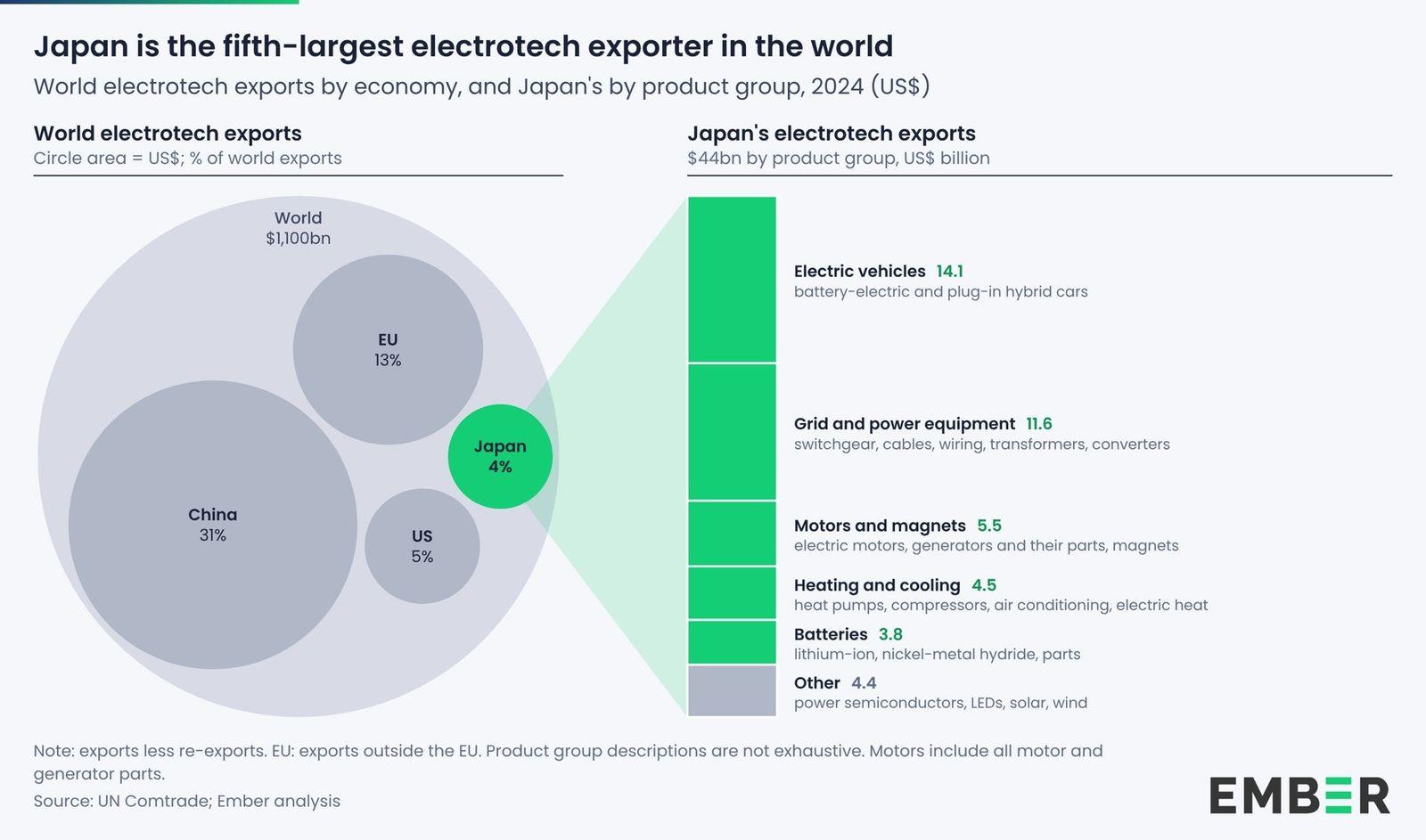
Japan exported US$44 billion of electrotech in 2024, led by EVs at US$14.1 billion and grid and power equipment at US$11.6 billion. Motors and magnets earned US$5.5 billion, heating and cooling US$4.5 billion and batteries US$3.8 billion. Only China, Germany, the US and Mexico exported more. Japan’s share of the US$1,100 billion world total was 4 per cent.
Murata is a key supplier of tiny capacitors inside phones and cars. Hitachi and Mitsubishi Electric are major grid suppliers, and Daikin sells heat pumps around the world. At home, Japan’s buildings and factories already run on electricity more than those of the EU, the US or China. Its lead is slipping in key areas such as batteries and EV drivetrains.
Ember’s proximity index, built on 2022 to 2024 export data from Harvard Growth Lab, shows how close each economy’s exports sit to four layers of the electric stack. Japan falls in the quite close band for infotech and electro-minerals. In electrotech and components, it sits between quite close and already leading. China is labelled as leading in infotech, electrotech and components, and Chile in electro-minerals.

Where the old export base is exposed
Ember found that fossil-fuel-linked exports in 2024 included US$64 billion of engine cars, US$30 billion of hybrids and US$24 billion of engines and parts, the core business of Japan’s carmakers. Together with other fossil fuel equipment, the category earned US$161 billion. The pressure is already visible in Japanese carmakers’ falling share of global car sales since 2019.
“Japan’s carmakers built their global lead on the engine, and the engine is in terminal decline,” said Sam Butler-Sloss, Manager, Ember. “Asia is moving to electric cars faster than the industry expected, including in Southeast Asia, where Japanese brands have long been strongest. The Hormuz crisis is only speeding this up. Unless Japan pivots fast to electric cars, it will cede one of its biggest industries to China.”

“Japanese exports of fossil fuel-based technologies face clear structural barriers to growth: rising costs, intensifying regional competition, and accelerating end-use electrification in importing markets,” said Sam Reynolds, Research Lead, LNG/Gas, Asia at the Institute for Energy Economics and Financial Analysis. “For Japan, this is not a peripheral question—it’s an economic imperative.”
The fuel import bill
Japan spent a net US$161 billion on fossil fuel imports in 2024, about 4 per cent of GDP. Ember calculates that electrotech on the market today could replace around US$122 billion, or 76 per cent, of that bill. Renewables in power stations would account for US$61 billion, EVs in place of petrol and diesel cars for US$36 billion, and electric heating and cooking in buildings for US$20 billion. Fuel would fall from 22 per cent of Japan’s merchandise imports to 5 per cent.
The closure of the Strait of Hormuz in February 2026 showed the exposure, with more than 90 per cent of Japan’s crude oil coming from the Middle East. “Home-grown power is now the cheaper option,” said Dr Dinita Setyawati, Ember’s External Affairs & Strategic Impact Lead Asia. “Globally, at 2026 prices, power from new solar plus batteries costs under US$60 per megawatt-hour (MWh), against more than US$160/MWh for LNG-fired power.”
What Ember recommends
Ember says Japan’s current policies pull towards fuel. Japan has cut the tax on petrol, raised the surcharge on electricity and spent at least ¥13 trillion (about US$86 billion) since 2022 to hold down fuel prices. It has no target for the share of energy that comes from electricity, and fossil fuel consumption subsidies run at about 1 per cent of GDP a year.
For exporters, Ember calls for a home market for the technologies Japan already makes: real end dates for petrol cars and coal power, caps on how long fossil fuel contracts can run, and funding for suppliers and regions to switch before their markets shrink. To make electricity cheaper than fuel, it recommends shifting taxes from electricity to fossil fuels and moving green transformation (GX) money from hydrogen, ammonia and carbon capture and storage to electrotech. It also recommends a national electrification target, with solar, wind, grids and batteries planned as one system.
“Japan has the engineering base and some of the world’s lowest borrowing costs. It should be one of the big winners of the electric age,” said Kingsmill Bond, Director, Ember. “Every yen spent propping up the old system is a yen not spent building the home market that Japan’s electrotech companies need to compete abroad.”
About Ember: Ember is an independent energy think tank that aims to accelerate the clean energy transition with data and policy. The report, Japan and the electrotech revolution, is available at ember-energy.org/latest-insights/japan-and-the-electrotech-revolution.
Source: Ember, Japan and the electrotech revolution (11 November 2026). Charts: Ember.