Huawei Rolls Out 11 AI Chip Designs as Supply Trails Domestic Orders
The Shenzhen giant's newest Ascend accelerators, CPUs and interconnect silicon target the data centre stack Nvidia has dominated, even as Beijing-based demand outpaces production.
A Portfolio Play Against Export Restrictions
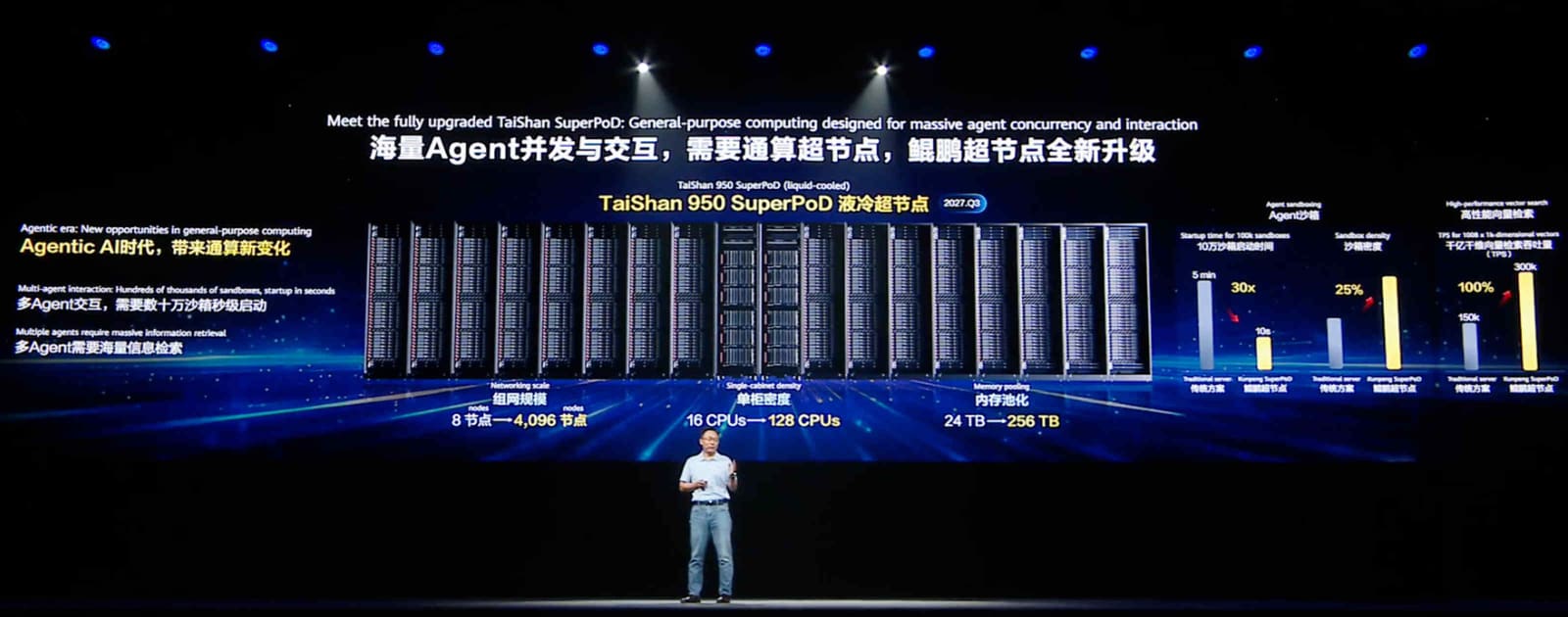
Huawei unveiled 11 chip designs for artificial intelligence infrastructure on 17 September, spanning accelerators, central processing units and high-speed interconnect silicon. The announcement, made during the company's annual developer conference, underscores a strategy to build a vertically integrated AI computing stack despite US export controls that have blocked access to leading-edge foundry nodes and advanced packaging.
At Opentechwire, we have tracked Huawei's semiconductor roadmap since Washington placed the firm on the Entity List in 2019. This latest portfolio represents the most comprehensive attempt by any Chinese company to replicate the data centre ecosystem that Nvidia, Intel and AMD have spent decades refining. The new chips include next-generation Ascend accelerators - Huawei's answer to Nvidia's H100 and H200 GPUs - as well as updated server processors and networking silicon designed to knit together clusters of thousands of nodes.
Huawei stated that domestic demand for Ascend chips already exceeds available supply, a signal that Chinese cloud operators and internet giants are racing to secure alternatives to embargoed American hardware. The supply-demand imbalance also points to bottlenecks in China's semiconductor manufacturing capacity, particularly at the 7-nanometre and 5-nanometre process nodes where leading AI accelerators are typically fabricated.
The Architecture Beneath the Announcement
The chip portfolio targets three layers of the AI data centre. First, the Ascend accelerator family handles matrix multiplication and other tensor operations central to training large language models and running inference workloads. Second, the CPU lineup - likely an evolution of Huawei's Kunpeng Arm-based server processors - manages orchestration, memory hierarchy and general-purpose compute. Third, the interconnect chips address the east-west traffic between accelerators, a domain where Nvidia's NVLink and Broadcom's custom switching silicon have set performance benchmarks.
Huawei has not disclosed clock speeds, memory bandwidth, or power envelopes for the new designs, making direct comparisons difficult. Industry engineers note that China's domestic foundries - primarily Semiconductor Manufacturing International Corporation - can produce 7-nanometre chips in volume but face yield and performance gaps relative to Taiwan Semiconductor Manufacturing Company's N5 and N3 processes. Those gaps translate into higher power consumption per operation, a critical metric in data centres where electricity and cooling costs dominate total cost of ownership.
The decision to announce 11 designs at once suggests Huawei is offering customers a range of performance and price points, from edge inference chips to flagship training accelerators. This tiered approach mirrors the product segmentation that Nvidia, AMD and Intel all employ, allowing data centre operators to match silicon capability to workload requirements.
Demand Signals and Supply Constraints
Huawei's acknowledgment that Ascend demand outstrips supply offers a rare glimpse into the procurement pressures facing Chinese AI infrastructure. ByteDance, Alibaba Cloud, Tencent Cloud and Baidu have all disclosed plans to expand training capacity for generative models, yet access to Nvidia's A100, H100 and subsequent generations has been curtailed by US Commerce Department restrictions that took effect in October 2022 and were tightened in October 2023.
The shortfall creates an opening for Huawei, but also exposes the limits of China's domestic semiconductor ecosystem. SMIC's 7-nanometre process, achieved without extreme ultraviolet lithography tools from ASML, relies on multi-patterning techniques that increase manufacturing complexity and reduce throughput. Advanced packaging - chiplet integration, high-bandwidth memory stacking, and through-silicon vias - remains another chokepoint, with equipment from Applied Materials, Lam Research and Tokyo Electron subject to export licensing.
Chinese cloud operators have responded by stockpiling older-generation Nvidia GPUs, designing custom accelerators in partnership with domestic foundries, and extending the lifespan of existing clusters through software optimisation. Huawei's expanded Ascend portfolio gives these buyers a fourth option, though adoption will hinge on software maturity - specifically, the breadth of framework support, compiler efficiency and library coverage relative to CUDA, Nvidia's entrenched software moat.
The Competitive Landscape in Three Dimensions
Huawei's chip offensive unfolds along three competitive axes. First, performance per watt: can Ascend accelerators deliver comparable throughput to Nvidia's Hopper and Blackwell architectures while operating within the thermal and power budgets of standard data centre racks? Second, software ecosystem: will developers port models and training pipelines to Huawei's CANN framework, or will the friction of migration keep workloads locked into CUDA? Third, geopolitical resilience: does a fully domestic supply chain - from design tools to packaging - offset the performance and ecosystem disadvantages?
Intel and AMD face similar questions as they challenge Nvidia's dominance in AI accelerators. Intel's Gaudi line and AMD's Instinct MI300 series have made inroads with cloud providers seeking vendor diversity, yet neither has captured more than single-digit market share in training workloads. Huawei operates under an additional constraint: its customer base is largely confined to China, limiting the scale economies and developer mindshare that come from global deployment.
Nvidia's response has been to accelerate its roadmap, shipping new architectures annually and tightening integration between silicon, networking and software. The company's Spectrum-X Ethernet platform and NVLink Switch chips, introduced over the past 18 months, aim to make multi-node clusters faster and easier to deploy - raising the bar for any competitor attempting to displace installed infrastructure.
Forward Implications for Asia's Semiconductor Map
Huawei's 11-chip announcement is less a direct threat to Nvidia's near-term revenue than a signal of China's determination to build parallel infrastructure. The supply shortfall Huawei cited suggests that even with policy support and captive demand, scaling production of advanced AI silicon remains a multi-year engineering and capital challenge.
For Taiwan, South Korea and Japan - home to TSMC, Samsung Foundry, SK hynix and a cluster of materials and equipment suppliers - the bifurcation of the AI chip market creates both risk and opportunity. TSMC's Arizona and Kumamoto fabs, Samsung's Texas expansion, and SK hynix's new HBM packaging lines in Indiana all reflect efforts to de-risk supply chains amid US-China technology decoupling. Yet those same firms rely on Chinese customers for a significant share of revenue, a dependency that complicates long-term strategic planning.
Huawei's next test will be production ramp and customer validation. Announcing chip designs is the simpler part; delivering them at scale, with competitive performance and a software stack that developers will adopt, is the enduring challenge in semiconductor competition.