Asia's Utilities Are Ordering Batteries by the Gigawatt
Thailand has drafted 14.5 GW of new storage by 2037 and Vietnam up to 16.3 GW by 2030, while electric two-wheeler sales across Southeast Asia more than doubled in the first quarter of 2026. A briefing published this week finds Japanese-backed project portfolios barely touching either category.
Vietnam's revised power plan targets up to 16.3 GW of battery storage by 2030. Thailand's draft plan for 2026 to 2050 lists 14.5 GW of new systems by 2037. PLN in Indonesia has set 6 GW of utility-scale storage and a further 3.6 GW paired with solar by 2035. The Philippines counts roughly 1,000 MW operational or in the pipeline. None of these are aspirational slides in a conference deck. They are procurement lines inside national power development plans, and together they describe an equipment market forming over the next decade.
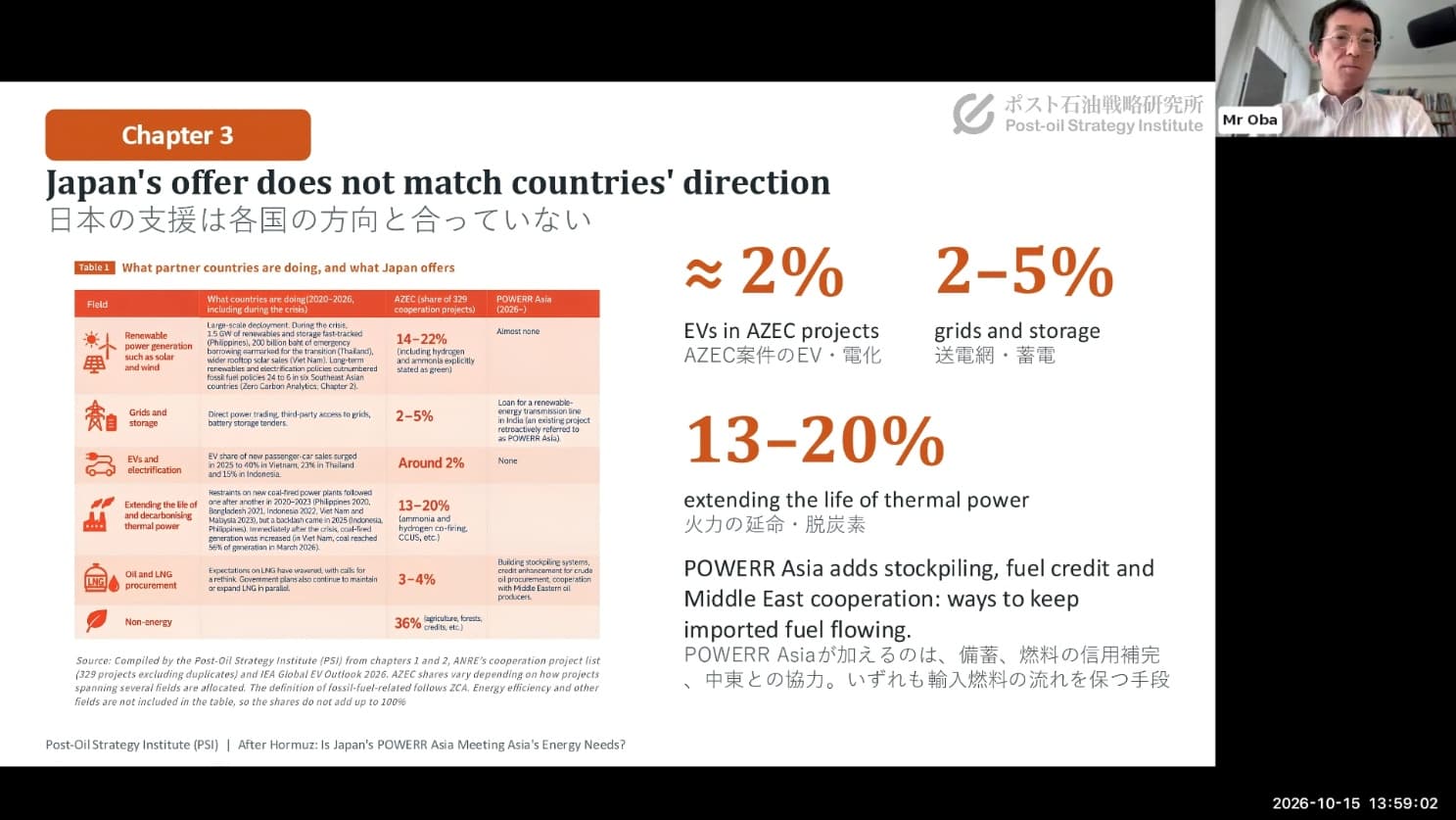
At Opentechwire we have tracked the gap between announced energy partnerships in the region and the hardware those partnerships actually finance. A briefing released on 15 October by Noriaki Oba of the Post-Oil Strategy Institute, with the Global Strategic Communications Council and Ember, puts a number on that gap from the supplier side, and the number is small.
The Order Book
The underlying driver is variable renewable capacity. Across ASEAN that stood at 53.7 GW in 2024 and is projected by the ASEAN Centre for Energy and the International Energy Agency to reach about 231 GW by 2030, roughly 28 per cent of installed capacity and 21 per cent of generation across their scenarios. Storage follows as a matter of physics. The ASEAN Renewable Energy Long-term Roadmap points to storage capacity growing about fivefold from 2024 levels.
The modelling also shows how far behind some targets sit. Cambodia would need around 2 GW of storage to support a 42 per cent renewable share by 2030, against a national target of 200 MW. That is a tenfold shortfall in a single market, and it is the kind of number that turns into tenders.
Why the Bottleneck Is Regulatory
For vendors, the interesting finding in the ACE and IEA work is that the constraints on integrating variable renewables are, in their words, "policy and regulatory rather than technical". Most ASEAN power markets still run on a single-buyer model, so long-term offtake agreements, capacity payments and regulated procurement determine whether a storage project gets financed at all.
Several grid codes in the region still do not define performance requirements for storage providing grid-support services, which leaves developers negotiating specifications case by case. Asset classification is unsettled, since a battery counts as generation when discharging and as load when charging, and the two are taxed and dispatched differently. Connection queues are adding delay on top. Expensive capital, uncertain revenue and currency risk complete the picture.
That combination favours suppliers who can arrive with financing attached rather than equipment alone. It is a structural advantage available to any export credit system willing to use it.

Two and Three Wheels Move First
Road transport in the region is electrifying from the bottom of the vehicle stack upwards. Electric two-wheeler sales in Southeast Asia more than doubled year on year in the first quarter of 2026, according to IEA analysis, after doubling in Vietnam across 2025. Indian sales grew by more than 30 per cent year on year over the same quarter. Globally the sales share of electric three-wheelers passed 25 per cent in 2025 even as the overall three-wheeler market shrank.
Electric car sales in Southeast Asia more than doubled in 2025 to a share approaching 20 per cent, led by Vietnam, Indonesia and Thailand. Across Asia Pacific excluding China, sales rose about 80 per cent year on year in the first quarter of 2026. Price convergence is part of the explanation. Electric and combustion cars have carried comparable prices in Thailand for two years, and the Indonesian premium fell from above 50 per cent in 2024 to about 40 per cent in 2025.
Small vehicles matter disproportionately for importing economies because they consume refined product that has to be paid for in foreign currency. Every scooter fleet that switches to charging reduces an exposure that the disruption at the Strait of Hormuz made expensive in a matter of weeks.
What the Japanese Portfolios Contain
Set against that demand profile, the composition of Japanese-backed portfolios is the finding worth noting. The briefing puts electric vehicles and electrification at about 2 per cent of AZEC project portfolios, grids and storage at 2 to 5 per cent, and life extension or decarbonisation of thermal power at 13 to 20 per cent. POWERR Asia, the ¥1.5 trillion framework announced on 15 April 2026, adds oil stockpiling, credit support for fuel purchases, storage tanks and cooperation with Middle Eastern producers.
Those are coherent instruments for keeping imported fuel flowing during a supply interruption. They are a poor fit for a utility writing a tender for 16 GW of batteries, or a city procuring charging infrastructure for a two-wheeler fleet. The briefing also records that Japan's loan to Bangladesh during the disruption came to roughly one tenth of the approximately US$3 billion extended by the Asian Development Bank, the World Bank and the AIIB.
The Supplier Question
Japanese manufacturers are not absent from these technologies. Grid equipment, power electronics, battery cells and heat pump systems are established export categories with installed bases across the region. The constraint described in the briefing sits upstream of the factories, in how the public financing instruments are scoped. Stockpiling credit does not pull a transformer order behind it. Concessional finance for a substation or a storage system does.
There is a competitive clock attached. Chinese suppliers have been the default source for cells and inverters in several of these markets for years, and multilateral lenders are already financing the grid work that makes storage dispatchable. Procurement relationships formed during the first wave of utility-scale storage in ASEAN will shape maintenance, replacement and upgrade cycles into the 2040s.
What 3 November Will Show
Ember will publish a Japan electrotech brief on 3 November, which is expected to map where Japanese equipment exports could fit against regional demand. The useful detail will be category-level: whether the analysis identifies specific product lines with existing capacity, and whether it quantifies the addressable volume in the storage, grid and small-vehicle segments rather than describing the opportunity in general terms.
The technical demand signal in Southeast Asia is now explicit enough to plan against. Plan targets are published, the regulatory obstacles have been catalogued by the region's own energy institutions, and the vehicle segments that move first are visible in quarterly sales data. What remains undecided is which supplier base arrives with the financing structure that regional utilities can actually sign.