Amazon's Satellite Ambitions Hit by First Vulcan Failure
United Launch Alliance lost 40 Project Kuiper broadband spacecraft when its heavy-lift vehicle encountered an anomaly ten minutes after liftoff, marking the company's first mission loss in two decades
Launch Ends in Loss
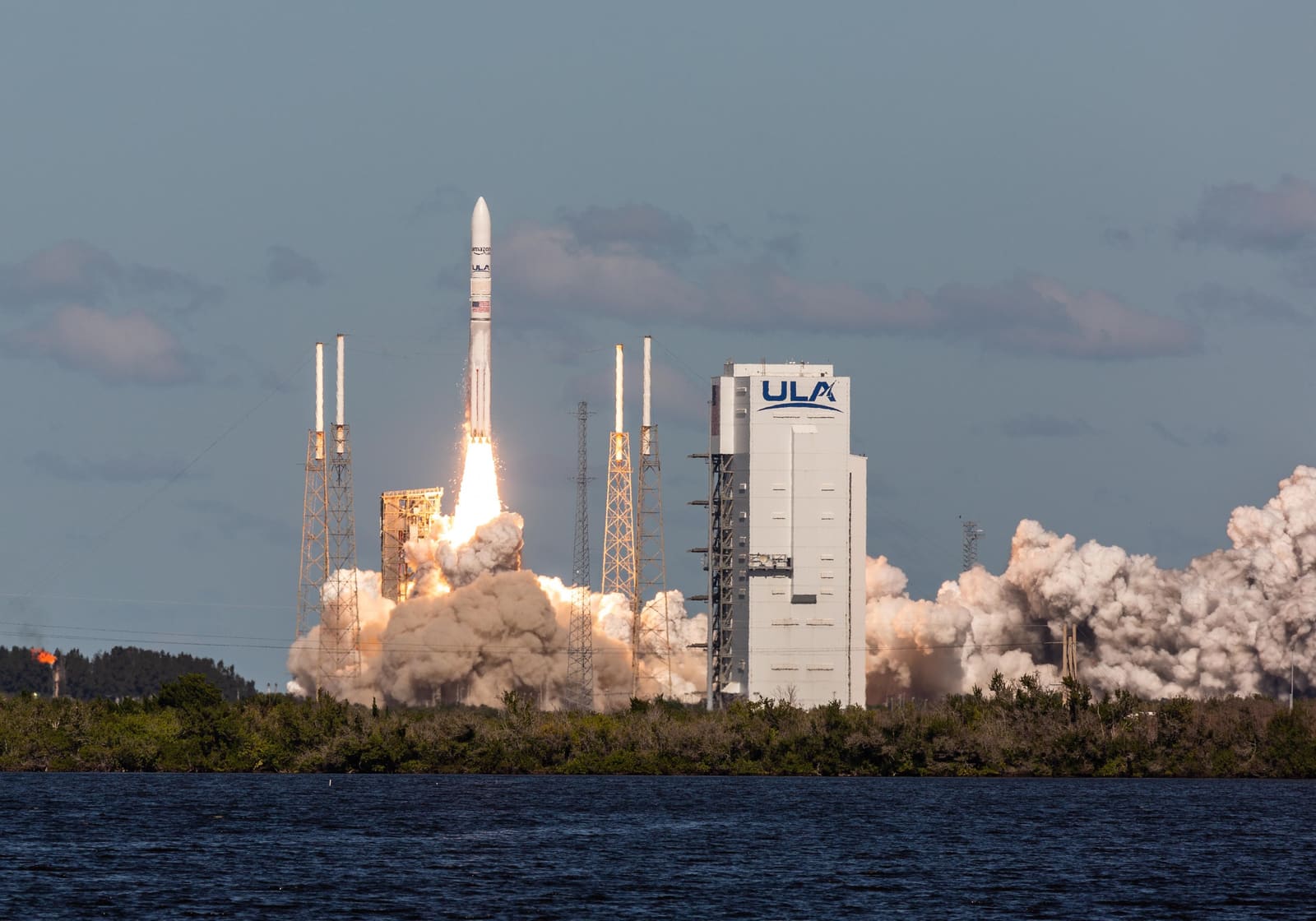
A United Launch Alliance Vulcan rocket carrying 40 Amazon broadband satellites failed to deliver its payload to orbit on 15 November, marking the first mission failure in the launch provider's 20-year operating history. The vehicle, designated LV-01, lifted off from Space Launch Complex 41 before encountering what the company described as an "anomaly" ten minutes into flight.
The loss represents a significant setback for Amazon's Project Kuiper, the e-commerce giant's effort to build a low-Earth-orbit constellation capable of competing with SpaceX's Starlink network. The 40 spacecraft destroyed in the incident were meant to inaugurate a 38-mission contract between Amazon and United Launch Alliance, one of the largest commercial launch agreements announced in recent years.
United Launch Alliance confirmed the failure in a statement published on social media, noting that telemetry received by the launch director indicated the vehicle had not achieved the trajectory necessary to place the satellites into their intended orbit. The company has opened an investigation but has not yet identified the root cause of the anomaly.
A Rare Stumble for an Established Player
United Launch Alliance, a joint venture between Boeing and Lockheed Martin formed in 2006, has built a reputation on reliability. The company's fleet of Atlas V and Delta IV rockets completed more than 150 consecutive successful missions before the Vulcan programme began replacing the older vehicles. That track record made United Launch Alliance the preferred provider for high-value national security payloads in the United States, including reconnaissance satellites and classified defence missions.
The Vulcan rocket, designed to replace the Atlas V and Delta IV families, completed two certification flights earlier in 2026 before being cleared to carry commercial and government payloads. Those earlier missions, which flew in March and July, placed dummy masses and secondary payloads into their target orbits without incident. The 15 November flight was the first operational mission carrying a customer's primary payload.
The failure raises questions about the pace at which United Launch Alliance can return Vulcan to flight. Launch failures typically trigger months-long investigations, during which the vehicle remains grounded while engineers isolate the fault, redesign components if necessary, and validate fixes through testing. For Amazon, which has publicly committed to deploying half of its planned 3,236-satellite constellation by July 2029 to meet regulatory milestones set by the US Federal Communications Commission, any extended delay compounds an already tight schedule.
Project Kuiper's Uphill Climb
Amazon announced Project Kuiper in 2019, entering a market that SpaceX had already begun to dominate. By the time Amazon launched its first two prototype satellites in October 2023, SpaceX had more than 4,000 Starlink satellites in orbit and was signing up customers across North America, Europe, and parts of Asia. The competitive gap has only widened since then.
As of mid-November 2026, Amazon has fewer than 100 Kuiper satellites in orbit, all launched on missions flown by competitors to United Launch Alliance. The company has placed orders with Blue Origin for launches aboard the New Glenn rocket, and with Arianespace for flights on the Ariane 6 vehicle, but those providers have faced their own schedule pressures. Blue Origin's New Glenn has yet to complete its maiden flight, while Ariane 6 has flown only a handful of missions since debuting in mid-2024.
The 38-flight agreement with United Launch Alliance was meant to provide Amazon with a reliable, high-cadence option for deploying Kuiper spacecraft in batches of 40 or more. Vulcan's payload capacity, roughly 20 tonnes to low Earth orbit in its standard configuration, makes it well-suited to lifting multiple satellites at once. Losing the first mission in that series not only erases 40 spacecraft from Amazon's manifest but also introduces uncertainty into the launch schedule for the remainder of the contract.
Amazon's public response to the failure struck a measured tone. In a statement, the company acknowledged the inherent risks of spaceflight and described United Launch Alliance as a "trusted partner", expressing confidence that the launch provider would identify the cause and resume operations. That vote of confidence may reflect pragmatism as much as optimism; Amazon has few alternatives if it hopes to meet its 2029 deployment deadline, and switching launch providers mid-contract would introduce additional delays and costs.
Implications for the Broadband Constellation Race
The failure highlights the fragility of large-scale satellite deployment campaigns, which depend on both spacecraft production and launch availability proceeding without major interruption. SpaceX has been able to maintain its lead in the broadband constellation market in part because it controls both elements: the company manufactures Starlink satellites in-house and launches them on its own Falcon 9 rockets, which have flown more than 300 times since 2010 with only two in-flight failures.
Amazon, by contrast, must coordinate with multiple external suppliers. The company is building Kuiper satellites at a factory in Kirkland, Washington, but relies entirely on third-party launch providers to deliver them to orbit. That model introduces dependencies that can cascade when any single element falters.
The delay also matters in the context of spectrum licensing. The US Federal Communications Commission granted Amazon permission to operate Project Kuiper on the condition that the company deploy at least half its constellation within six years of the authorisation, which was issued in July 2020. That sets a hard deadline of July 2026 for 1,618 satellites to reach orbit. Amazon has requested extensions in the past, and regulators have shown some flexibility, but each setback makes the company's position more precarious.
For United Launch Alliance, the failure arrives at a moment when the US launch market is more competitive than it has been in decades. SpaceX dominates commercial and government contracts, while newer entrants such as Rocket Lab and Relativity Space are scaling up their vehicles to carry heavier payloads. United Launch Alliance has positioned Vulcan as a cost-competitive alternative to SpaceX's Falcon 9, but sustained reliability is the company's core selling point. A lengthy grounding could erode customer confidence and open the door for competitors to capture missions that would otherwise have flown on Vulcan.
What Comes Next
United Launch Alliance has pledged transparency as it investigates the cause of the 15 November anomaly, but the company has not provided a timeline for completing that work or returning Vulcan to flight. Historical precedent suggests the process will take several months at minimum. When SpaceX's Falcon 9 experienced an upper-stage failure in July 2024, the vehicle was grounded for two weeks while engineers identified a liquid oxygen leak. More complex failures, such as the loss of a Falcon 9 in 2016 during pre-launch fuelling, required four months to resolve.
Amazon, meanwhile, must decide whether to wait for Vulcan to return to service or accelerate deployment on alternative vehicles. Blue Origin has indicated that New Glenn could begin commercial operations in early 2027, assuming its debut flight succeeds. Ariane 6 is already operational but has a limited manifest and lower flight rate than Amazon's deployment schedule requires. The company could also explore options with SpaceX, though that would mean relying on the same launch provider that operates its primary competitor in the broadband market.
The broader satellite industry will be watching closely. Large constellations, whether for broadband internet, Earth observation, or other applications, have become a central theme in the space economy over the past five years. The business model depends on deploying hundreds or thousands of satellites quickly and at manageable cost. When launch failures disrupt that cadence, the financial and schedule impacts ripple through the entire value chain, from spacecraft manufacturers to ground-station operators to the investors funding these ventures.
For now, Amazon's satellite ambitions remain intact but delayed. The company has the financial resources to absorb the loss of 40 spacecraft and the schedule slip that will follow. What it cannot easily replace is time. Every month that passes without satellites reaching orbit is a month in which SpaceX extends its lead, signs more customers, and builds a more entrenched position in a market that may only support one or two large players. The 15 November failure did not end Project Kuiper, but it made the path forward steeper.