Alibaba Shifts AI Strategy Towards Infrastructure Efficiency and Revenue
The Hangzhou giant's Apsara Conference signals a move from pure capability demonstration to operational discipline, even as capital spending climbs.

A Discipline Turn in Hangzhou
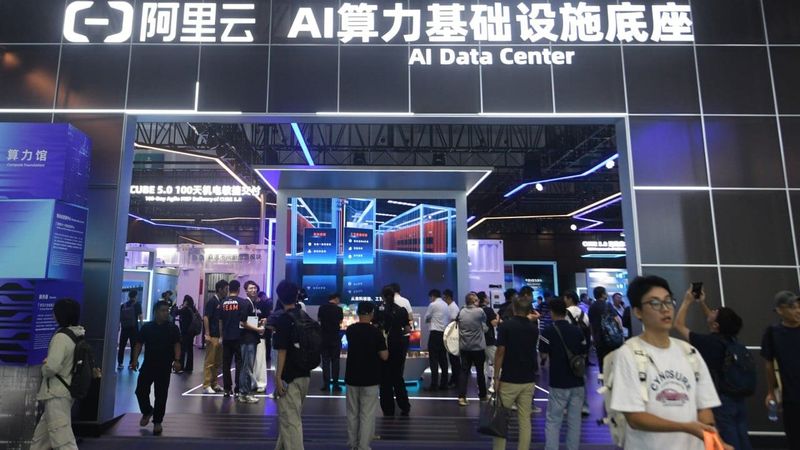
Alibaba's flagship technology conference this September revealed something more interesting than new model benchmarks: a recalibrated approach to artificial intelligence that prioritises operational returns over raw capability expansion. The three-day Apsara Conference, held from 24 to 26 September under the theme "Intelligence goes beyond", laid out what analysts are describing as a full-stack ecosystem managed with tighter financial discipline.
At Opentechwire, we've tracked the capital expenditure trajectories of China's major cloud operators over the past eighteen months. Alibaba's spending on AI infrastructure has accelerated sharply, yet the messaging at Apsara suggested the company is now equally concerned with extracting revenue from that investment. This dual focus on both scale and efficiency represents a maturation of strategy in a market where the initial AI gold rush is giving way to harder questions about unit economics.
Infrastructure Spend Meets Monetisation Pressure
The conference presentations emphasised pathways to commercialisation that extend beyond developer API access. Alibaba is positioning its AI stack to serve enterprise clients with specific vertical requirements, an approach that demands not just inference speed but also cost predictability and integration into legacy systems. That requires infrastructure tuned for efficiency rather than purely for performance at any price.
Capital expenditure on GPU clusters, data centre expansion, and networking fabric has become a defining characteristic of the current AI cycle across Asia. Alibaba's spending pattern mirrors that of its regional peers, yet the Apsara messaging suggests the company is now balancing that outlay with concrete revenue models. The emphasis on pragmatism reflects broader investor pressure across Chinese tech to demonstrate profitability from AI investments, not merely capability.
Full-Stack Positioning in a Fragmented Market
Alibaba's AI ecosystem spans model training, inference optimisation, developer tooling, and cloud delivery. The full-stack narrative is not unique to Alibaba, but the company's execution has been more disciplined than some competitors who have spread resources across disconnected initiatives. At Apsara, the integration of these layers was presented as a competitive advantage, allowing clients to deploy AI workloads without stitching together components from multiple vendors.
This matters in enterprise sales, where procurement cycles favour vendors who can deliver end-to-end solutions with clear service-level agreements. Alibaba's cloud division has been refining this pitch over the past year, targeting sectors such as logistics, retail, and manufacturing where AI adoption is moving from pilot projects to production deployment. The challenge lies in proving that the stack delivers measurable efficiency gains, not just technical elegance.
Efficiency as a Strategic Differentiator
Infrastructure efficiency emerged as a recurring theme throughout the conference. This encompasses everything from model compression techniques that reduce inference latency to workload scheduling algorithms that maximise GPU utilisation. For cloud operators, efficiency translates directly into margin improvement, a metric that matters more as the market matures and price competition intensifies.
Alibaba's focus on optimisation reflects lessons learned from earlier cloud infrastructure buildouts, where overcapacity and underutilisation eroded profitability. The AI infrastructure wave risks repeating those mistakes if operators prioritise scale without attention to utilisation rates. By foregrounding efficiency at Apsara, Alibaba is signalling to both investors and enterprise clients that it understands the economics of AI deployment at scale.
The technical specifics shared at the conference included advances in model distillation, which allows smaller, faster models to approximate the performance of larger ones, and improvements in distributed training frameworks that reduce the time and cost required to fine-tune models for specific use cases. These are not headline-grabbing breakthroughs, but they are the kind of incremental improvements that determine whether AI infrastructure becomes a profitable business or a capital sinkhole.
Regional Context and Competitive Dynamics
Alibaba's strategic pivot occurs within a broader regional context where Chinese AI firms face both opportunity and constraint. Export controls on advanced semiconductor technology have forced Chinese cloud operators to extract more performance from existing hardware and to invest in domestic alternatives. This has accelerated work on efficiency and optimisation, turning a geopolitical constraint into a potential competitive advantage in markets where cost per inference matters more than absolute performance.
The regional AI infrastructure landscape is increasingly competitive, with Tencent, Baidu, and ByteDance all investing heavily in their own cloud and AI platforms. Alibaba's differentiation hinges on its established enterprise customer base and its experience operating large-scale infrastructure. The Apsara messaging aimed to reinforce that positioning, presenting Alibaba as the operator best equipped to help enterprises navigate the transition from experimental AI projects to production workloads that must meet reliability and cost targets.
What the Shift Reveals About Market Maturity
The pragmatic tone at Apsara reflects a broader shift in the Asian AI market from capability demonstration to operational execution. The initial phase of the current AI cycle was characterised by rapid model releases, benchmark leaderboard competition, and ambitious infrastructure buildouts. That phase is not over, but it is now overlapping with a second phase where revenue models, margin structure, and customer retention become the metrics that matter.
For Alibaba, this transition is both a challenge and an opportunity. The company must continue investing in infrastructure to remain competitive, yet it must also prove that those investments generate returns. The emphasis on monetisation and efficiency at Apsara suggests that Alibaba's leadership believes the market is ready for this more disciplined narrative. Whether enterprise clients agree, and whether the infrastructure delivers the promised efficiency gains, will determine whether this strategic pivot succeeds.
The Apsara Conference has historically served as a venue for Alibaba to showcase technical ambition. This year's event retained that ambition but tempered it with operational realism. In a market where capital is no longer infinite and patience for unprofitable growth is wearing thin, that combination may prove more valuable than pure capability alone.